



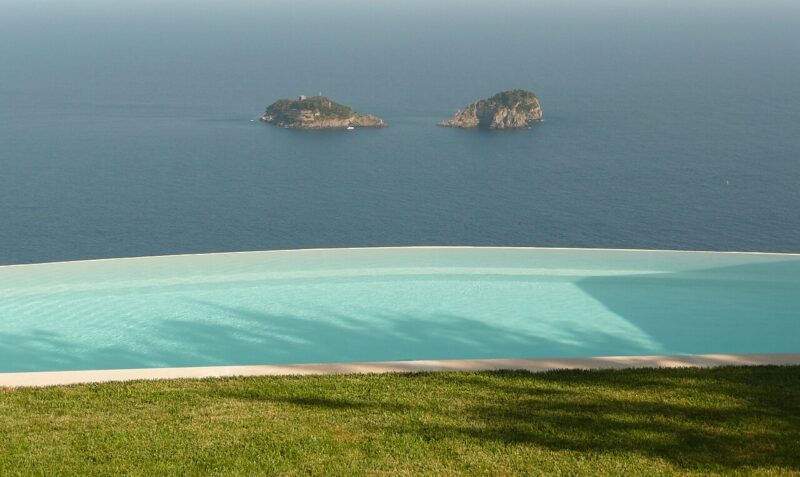
Mallorca has one of the densest concentrations of private swimming pools in Europe. The island counts tens of thousands of them, from village patios in the interior to estate pools above Palma. It also has a water problem. Reservoir levels have swung sharply in recent years, and several municipalities have responded to dry summers with restrictions that limit or ban the filling of private pools with mains water.
For the construction sector on the island, that combination is not killing demand. It is redirecting it.
Renovation is overtaking new construction
A large share of the Mallorca pool stock dates from the building booms of the eighties and nineties. Those pools are now thirty or forty years old, and they leak. An ageing shell can lose thousands of litres a week through cracks, tired grouting and worn pipework, losses that were tolerable when water was cheap and unrestricted, and that are increasingly unacceptable now.
The economics have become simple. A full renovation of an existing pool on the island typically costs 8,000 to 20,000 euros, against 18,000 to 30,000 euros for a new tiled concrete build of the standard 8×4 metre format. When a renovation also stops a chronic leak, the water saving compounds the case. Local repair specialists report that leak detection, crack repair and regrouting have become year round work rather than a spring rush.
What owners are actually buying
The specification of an average project has shifted visibly. Saltwater chlorination systems, at roughly 1,200 to 2,500 euros installed, reduce chemical handling and suit pools that are kept covered for longer periods. Covers themselves have moved from accessory to standard, cutting evaporation, which is the single largest source of water loss from a pool in the Mallorcan climate. Heat pumps, at 3,000 to 7,000 euros installed, extend the season and make a smaller, better insulated pool more attractive than a larger unheated one.
Even the humble refill has a price tag that concentrates minds. Filling a standard 8×4 pool takes around 48,000 litres, and a tanker delivery costs roughly 100 to 150 euros where mains filling is restricted. Owners who once emptied and refilled every season are being advised to maintain water quality year round instead, which in turn feeds the market for monthly service contracts, typically 150 to 250 euros on the island.
A market becoming more transparent
Pricing in the sector has historically been opaque, with quotes varying widely for identical work. That is changing as owners comparison shop online before contacting builders. Platforms now publish reference figures for the island, including the 2026 pricing guide from Mallorca Pool Builders, which lists typical ranges for new builds, renovations, equipment and permits across the Mallorcan municipalities. Builders who quote within published ranges close faster, and the outliers face harder questions than they did a decade ago.
Permitting adds its own layer. A licencia de obras from the local town hall runs 300 to 1,500 euros plus a construction tax of around 3 to 4 percent of the build cost, and rural plots fall under Balearic rules that govern what can be built on suelo rustico at all.
The outlook
None of the underlying drivers are going away. The housing stock keeps ageing, the climate keeps drying, and the regulatory direction across the Balearics points toward tighter water rules, not looser ones. For the trades on the island, the message from the data is consistent. The growth market on Mallorca is not digging new holes. It is making the existing ones tight, efficient and cheap to run.
Photo: Villa Miragalli infinity pool via Wikimedia Commons, CC BY-SA 3.0.