



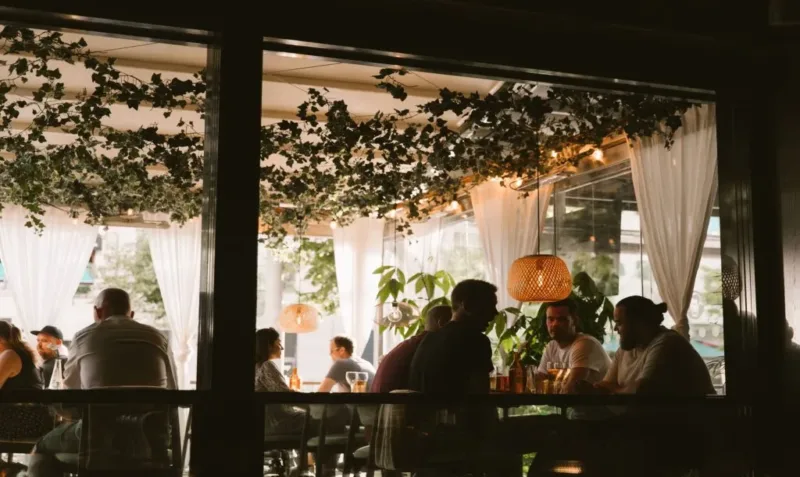
It is Sunday morning, and a restaurant that would otherwise be half empty is filling up instead. Tables are booked in pairs and in groups of eight, the buffet is topped up, the coffee keeps coming. For the guest, it is a slow start to the day. For the restaurant, it is something else entirely: one of the most profitable stretches of the week, at a time when the dining room used to be a cost rather than a source of income. Brunch has quietly become one of Swedish hospitality’s steadiest businesses.
A word from 1895
The phenomenon is older than most people assume. The word “brunch” was coined back in 1895 by the British writer Guy Beringer, who argued in an essay titled “Brunch: A Plea” in Hunter’s Weekly for replacing the heavy traditional Sunday meals with something lighter and more sociable in the late morning. The word is a blend of breakfast and lunch, and the idea was as much social as culinary. Brunch, Beringer wrote, “sweeps away the worries and cobwebs of the week.”
The concept crossed the Atlantic and took hold in the United States, where it became a genuine institution in the 1930s. From there it spread, as so much of modern food culture has.
The road to Sweden
Brunch arrived in Sweden on a broader scale during the 1980s, and Gothenburg is often mentioned as one of the early adopters. For a long time it stayed a big-city affair, something you did at a hotel or one of a handful of restaurants in the largest cities.
The real breakthrough came in the 2000s. Brunch went from a small luxury to something widely available, spreading from the major cities out across the country. Over the past fifteen years social media has given it a further push. A beautifully laid brunch table is easy to photograph, and those images have in turn made the meal a social marker: a way of spending time together that also gets seen. What began as an English plea for calmer Sundays has become a Swedish weekend tradition.
Why the industry likes brunch
Behind the pleasant surface sits a business logic that explains why so many restaurants have leaned into brunch. Several things line up at once.
First, brunch fills dead time. Sunday morning is otherwise one of the weakest slots in a restaurant’s week. Filling the room then, with staff who need to be on site anyway, sharply improves the use of both space and labour.
Second, the format is efficient. A buffet or an all-you-can-eat model lets the kitchen cook in larger batches and at a steadier pace than à la carte, while the guest gets clear value: you know what it costs, and you can eat your fill. That means predictable margins for the restaurant and an easy conscience for the diner.
Third, brunch is social by nature. People come in groups, stay for hours and often order something to drink alongside the food. A table occupied for two hours on a Sunday is worth more than one that turns over in twenty minutes. Add that brunch draws broad groups, families and friends and colleagues on their day off, and it becomes clear why it has grown into such a rewarding product to build a weekend operation around.
There is also the matter of what guests order on top. A glass of sparkling wine, a fresh juice or a final coffee with something sweet lifts the average bill without asking much more of the kitchen. In a sector where margins are often thin, that kind of add-on, layered onto a slot that is already busy, is exactly the sort of revenue that decides whether a Sunday turns a profit. And unlike a Friday night, no one has to stay open late to earn it.
A Gothenburg example
How this works in practice is easy to see in Gothenburg, one of the cities where brunch took hold early. On Avenyn, the Italian-American restaurant Joe Farelli’s runs an all-you-can-eat Sunday brunch where Italian dishes sit next to American comfort food. It is served every Sunday from September through May, precisely the half of the year when demand for a reason to go out is at its highest.
The setup says a good deal about how the industry thinks. The brunch is limited to the season when guests actually want it, it uses a format that is rational for the kitchen, and it is aimed at groups rather than solo lunch diners. None of that is accidental. It is a deliberately designed product.
A trend that has matured
The interesting thing about brunch is that it did not fade once the novelty wore off. Plenty of food trends come and go, but brunch has instead settled into a permanent place in the restaurant week. It has become an institution rather than a fad.
That tells you something about what lasts in hospitality. The concepts that survive are rarely the most spectacular ones, but the ones that keep the guest happy and the restaurant profitable at the same time. Brunch happens to do both. It gives the guest a relaxed Sunday and the restaurant a full room at a time that would otherwise stand empty.
So the next time you linger at the brunch table on a Sunday, with no particular reason to hurry, you are taking part in one of Swedish hospitality’s most quietly effective business ideas. That it also happens to be enjoyable may be the whole point.